 Largo Window
 Why Decks Near Indian Shores Wear Out Faster Than Inland Decks
Indian Shores sits on a barrier island in Pinellas County, wedged between the Gulf of Mexico and the Intracoastal Waterway, and that location changes what a deck has to survive. Homes just a few miles inland in Largo deal with Florida sun and summer storms, but a deck out on the island is also fighting constant salt air, direct onshore wind, and wind-driven rain that finds its way into every gap and fastener hole. Add near-daily UV exposure most of the year and you have a structure that ages differently than a deck built anywhere else in the county.
None of that means a deck can't hold up out there for decades. It means the material choice, the fasteners, the substructure, and the installation details all have to be selected with that environment in mind from the start, not treated as an afterthought after the boards are picked out.
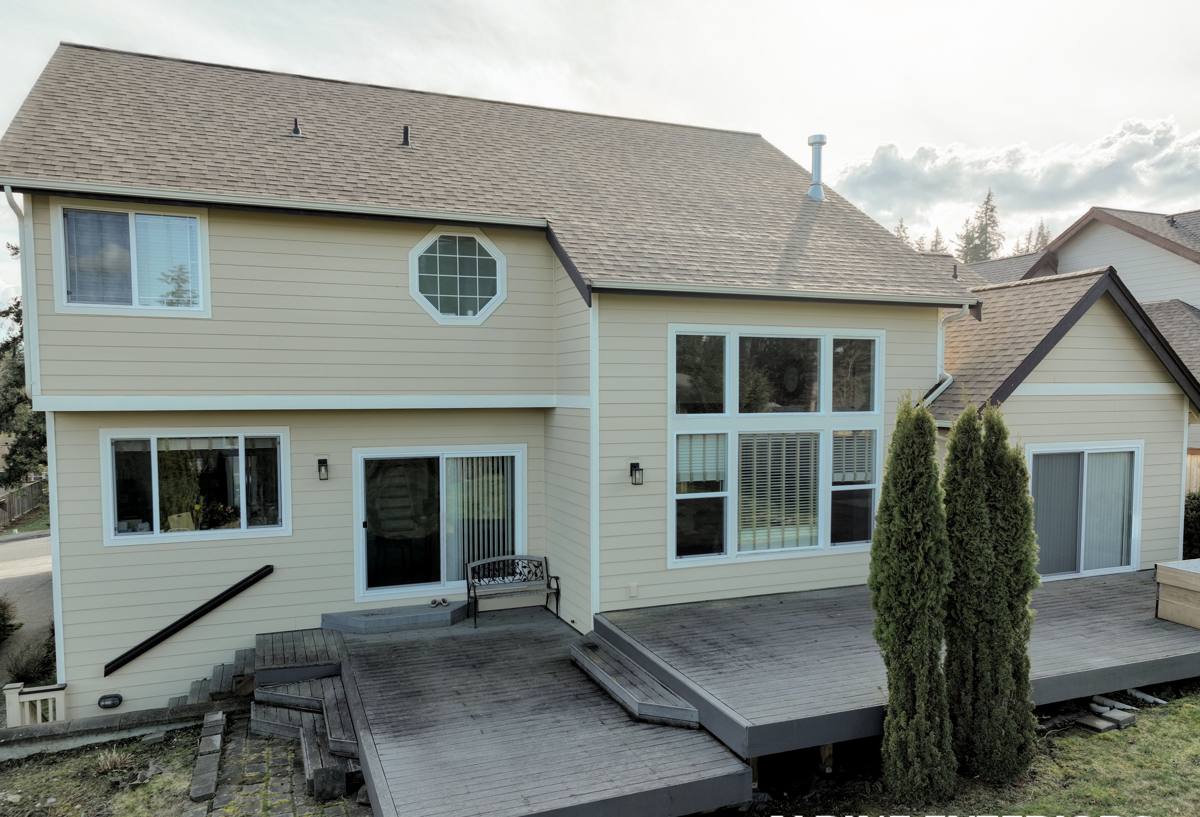
What "Composite" Actually Means
Composite decking is a blend of wood fiber and plastic, and the category covers a wide range of quality. The distinction that matters most for a coastal home is whether the board is capped or uncapped.
Capped Composite
Capped boards have a plastic polymer shell wrapped around the wood-fiber core. That cap is what actually faces the sun, the rain, and the salt spray — the core never gets exposed as long as the cap stays intact. This is the standard we install for homes in this area because it resists moisture intrusion into the core, which is the failure point that shortens the life of cheaper decking near the water.
Uncapped Composite
Older-style composite without a protective shell can absorb moisture at the surface over time, which leads to swelling, staining, and mold growth much faster in a humid, salty environment. We don't install uncapped composite on coastal jobs — the maintenance burden and shortened lifespan aren't worth what's saved up front.
Building the Substructure to Take Coastal Wind and Salt
The boards get the attention, but the frame underneath is what actually determines whether a deck survives a bad storm season. A few things we treat as non-negotiable on any deck near the water:
Fasteners and Hardware
Standard galvanized hardware corrodes faster in salt air than it does even a few miles inland. We spec stainless steel or coated fasteners rated for coastal/marine exposure on ledger connections, joist hangers, and hidden fastener clips — the parts you won't see again once the boards are down are exactly the parts that can't be an afterthought.
Wind Uplift and Attachment
Florida building code accounts for wind uplift on attached structures, and Pinellas County's coastal zones carry higher wind design requirements than inland jurisdictions. That means proper ledger flashing and attachment to the house, correctly spaced joists, and blocking sized for the actual wind exposure of the site — not just whatever spacing the decking manufacturer lists as a minimum.
Ground Contact and Elevation
Many homes on the island are built at an elevation that puts the deck substructure closer to grade, sandy soil, and standing water after heavy rain than a typical inland lot. Footings and any wood substructure components need ground-contact-rated treatment and enough clearance for airflow underneath — trapped moisture at grade is one of the most common causes of premature substructure failure we see on service calls.
Moisture, Humidity, and Mildew Control
Composite decking resists rot in the way solid wood can't, but it isn't immune to the effects of Florida's humidity. Mildew and algae growth on the surface is a cosmetic and slip-hazard issue that shows up faster in shaded, humid spots than in full sun.
- Proper board spacing lets water drain through instead of pooling on the surface
- Adequate under-deck ventilation keeps humidity from getting trapped below the boards
- Grooved-edge boards with hidden fasteners need consistent gapping so debris and moisture don't collect in the channel
- Boards installed too tight to the house or a wall restrict airflow and become the first spot mildew shows up
These are installation details, not product features — two decks built with the same boards can perform very differently depending on how the drainage and spacing were handled.
UV Exposure, Heat, and Color Choice
A deck out here gets more direct sun over the course of a year than almost anything else on the property. Cheaper composite can fade or discolor unevenly within a few seasons; quality capped boards use UV-stable pigments and stabilizers built into the cap itself to hold color longer.
Color also affects surface temperature. Darker boards run noticeably hotter underfoot in direct Gulf-coast sun, which matters for a deck that's likely to be barefoot territory most of the year. Lighter and mid-tone colors stay more comfortable, and several composite lines now offer heat-mitigating cap technology specifically aimed at this. It's worth weighing comfort against the look you want before locking in a color.
Our Installation Process
The process doesn't change dramatically because a home is on the island, but the level of attention at each step does.
- Site and structure assessment — checking existing ledger condition, elevation, drainage patterns, and wind exposure specific to the lot
- Permitting — pulling the required permit and confirming the design meets Pinellas County's coastal wind load requirements
- Substructure build or repair — framing, footings, and hardware selected for salt-air and ground-contact conditions
- Flashing and waterproofing — ledger board and any house-attached connections sealed against wind-driven rain intrusion
- Decking installation — boards laid with correct spacing, hidden or exposed fastening per the product spec, and attention to expansion gaps
- Railing and trim — fascia, stair components, and railing hardware matched to the same coastal-grade standard
- Final walkthrough — checking board gapping, fastener seating, and drainage before we call the job done
What Drives the Cost of a Composite Deck Here
| Factor | Why It Matters | Effect on Cost |
|---|---|---|
| Board tier (uncapped vs. capped vs. premium capped) | Determines moisture resistance and fade resistance | Wider range at the higher end for premium capped lines |
| Substructure condition | Existing framing may need full or partial replacement, especially on older homes | Can add significantly if the frame isn't sound |
| Fastener and hardware spec | Marine-grade stainless costs more than standard galvanized | Modest increase, but protects the larger investment |
| Deck size and shape | Cutouts, angles, and multiple levels add labor and waste | Scales with complexity, not just square footage |
| Railing system | Composite, aluminum, and cable railing all price differently | Can be a meaningful share of the total budget |
| Permitting and inspection | Required for any attached deck in the county | Fixed cost, not optional |
We give straightforward, itemized estimates rather than a single lump number, so you can see where the money is actually going and where there's room to adjust.
Keeping a Composite Deck in Good Shape Long-Term
- Rinse the surface periodically to clear salt residue, especially after storms with onshore spray
- Wash with soap and water a few times a year to prevent mildew buildup, more often in shaded areas
- Check railing and stair hardware annually for corrosion, even on stainless components
- Clear leaves and debris from between boards so moisture doesn't sit trapped in the gaps
- Inspect ledger flashing and the house connection point after major storms
- Avoid dragging metal furniture or grills that can scratch through the cap layer
Composite decking is marketed as low-maintenance, and compared to wood it is — but "low-maintenance" in a coastal environment still means some upkeep. Skipping it entirely is how a 25-year board ends up looking rough in eight.
Why It Matters Who Builds It
A lot of deck problems we get called out to fix didn't start with bad decking — they started with a build that didn't account for where the house actually sits. Standard fastener specs, generic joist spacing, and inland-style flashing details all hold up fine in a lot of Florida neighborhoods, but they fall short a few blocks from the Gulf. A crew that regularly works homes on this stretch of coast already knows where the wind loads run higher, where salt air eats through the wrong hardware first, and where drainage tends to be the real problem rather than the boards themselves.
That familiarity doesn't show up as a line item on an estimate, but it's the difference between a deck that needs attention in year three and one that's still solid well past year fifteen.
If you're planning a new composite deck or replacing an aging one in Indian Shores, we're happy to walk the site, look at what you're working with, and put together a straightforward, no-pressure estimate — just fill out the form below to get started.